

By Raj Mistry
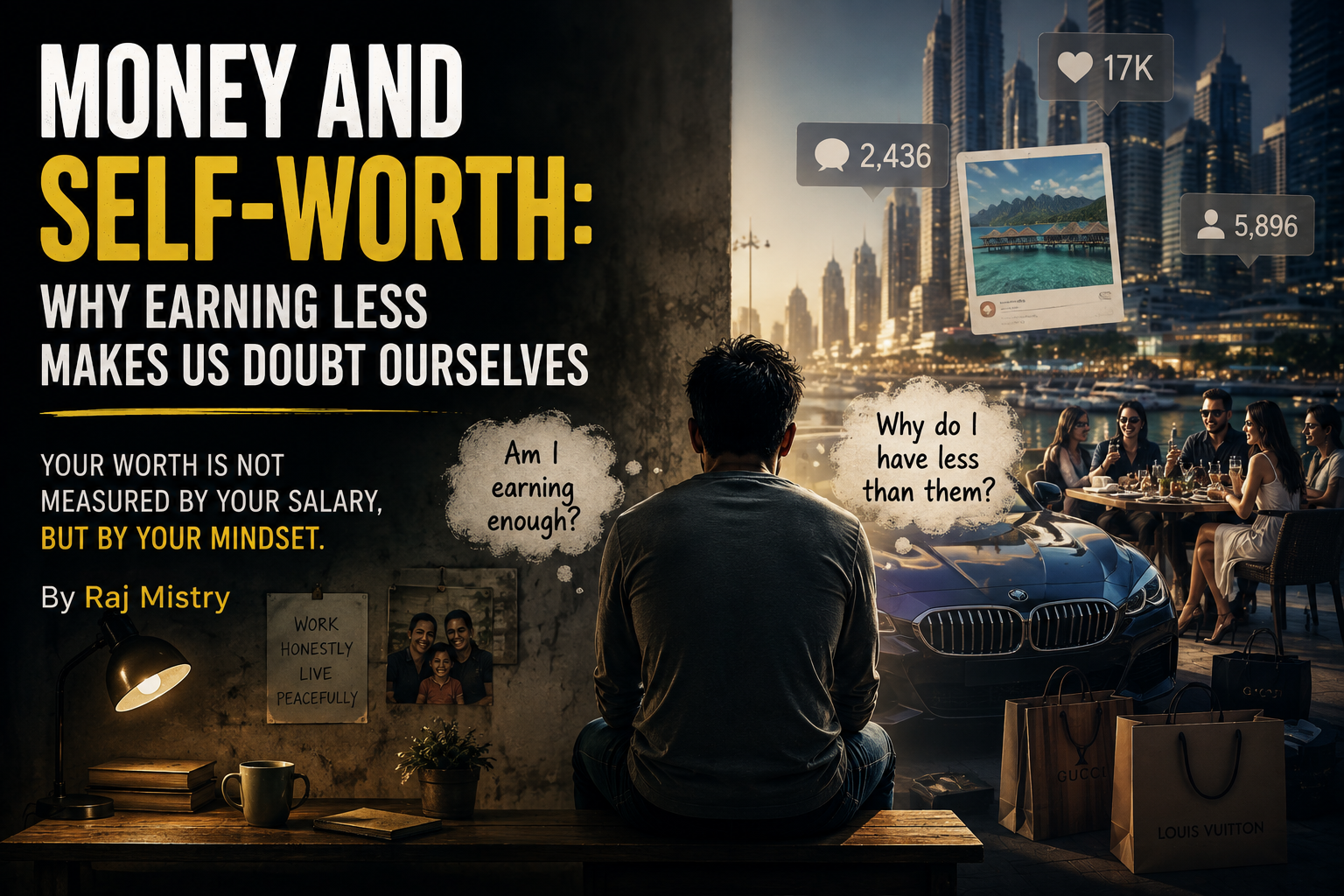
We live in a world where money has become more than a tool—it has become a measure of human worth.
Today, someone can work honestly, earn enough to feed their family, pay their bills, and sleep peacefully, yet still feel ashamed because they earn less than someone else. Not because they are struggling, but because society has quietly convinced them that a modest life is an unsuccessful one.
The tragedy isn’t that people want more money. Wanting financial security is natural. The tragedy is that we’ve started attaching our self-worth to our salary. We no longer ask, “Am I living a good life?” We ask, “Am I earning enough to impress other people?”
Somewhere along the way, money stopped being a way to live—and became the reason we judge ourselves.
When Comparison Becomes a Lifestyle
Comparison has always existed, but social media has turned it into a full-time habit.
Every day we scroll through photographs of luxury vacations, expensive restaurants, new cars, designer clothes, dream homes, and smiling faces that seem to have everything figured out. We know these are carefully selected moments, not everyday reality, yet our brain doesn’t fully separate the two.
Someone else’s holiday suddenly feels like proof that we’re falling behind. Their promotion becomes our insecurity. Their success quietly becomes our personal benchmark.
Without realizing it, we stop measuring our progress against our own past and start measuring it against someone else’s highlight reel.
That is where contentment begins to disappear.
Society Doesn’t Just Value Money—It Values What Money Represents
Money certainly brings comfort. It can reduce stress, create opportunities, and improve quality of life. But society has given it another role altogether.
Money has become a symbol of status.
People often assume competence because someone is wealthy. Expensive clothes, luxury cars, prestigious addresses, and frequent travel become signals of success long before anyone learns about a person’s character.
A teacher educating hundreds of children may feel embarrassed about earning less than someone posting luxury holidays online. A farmer feeding thousands of families may feel less successful than someone who simply appears wealthy on social media.
The problem isn’t income.
The problem is the belief that income determines importance.
Why More Money Never Feels Like Enough
Money does create happiness—but usually in short bursts.
You buy something you’ve wanted for months. For a while, it feels exciting. Then the excitement fades. Soon your mind adjusts to the new normal, and another purchase begins to look appealing.
Psychologists call this hedonic adaptation—our tendency to quickly get used to improvements and return to our previous level of satisfaction.
That is why people often remain trapped in a cycle:
Earn more.
Buy more.
Feel good briefly.
Want more.
The finish line keeps moving because the problem was never the amount of money. It was the belief that happiness was waiting just beyond the next purchase.
Money can provide comfort.
It cannot permanently provide contentment.
Have We Forgotten What Makes Life Rich?
Ask yourself a different set of questions.
Do you enjoy spending time with your family?
Do you laugh with your friends?
Do you sleep peacefully?
Do you wake up with purpose?
Do the people around you genuinely care about you?
These questions rarely appear in conversations about success, yet they often determine whether someone feels fulfilled.
A person with a modest income, good health, meaningful relationships, and peace of mind may quietly be living a richer life than someone earning ten times more while carrying constant stress and loneliness.
Money improves life.
It cannot replace it.
Richer Than Ever, Yet Less Satisfied
Modern society has achieved levels of wealth and convenience that previous generations could hardly imagine. We have faster transportation, better technology, instant communication, endless entertainment, and access to information at our fingertips.
Yet anxiety, burnout, loneliness, poor sleep, and constant comparison seem more common than ever.
In our pursuit of earning more, we’ve also accepted longer working hours, constant digital stimulation, polluted environments, processed food, and lifestyles that often leave little room for genuine connection.
Ironically, while our standard of living has improved, many people’s quality of life has become harder to protect.
Progress has brought remarkable advantages.
It has also come with psychological costs we rarely acknowledge.
What We Teach the Next Generation
Children learn far more from observation than instruction.
If they grow up watching adults constantly comparing salaries, worrying about status, and measuring success through possessions, they naturally begin believing that money determines value.
Instead, they should also see examples of gratitude, balance, meaningful work, generosity, and fulfillment.
A teacher can live a meaningful life.
A farmer can live a meaningful life.
A shopkeeper, nurse, mechanic, artist, or security guard can all live meaningful lives.
No profession should require someone to apologize for earning an honest living.
The goal is not to teach children that money doesn’t matter.
The goal is to teach them that money should support life—not define it.
Final Thought
There is nothing shameful about earning less through honest work.
The real tragedy is feeling ashamed because society taught you that your salary is your identity.
Earn well. Build wealth. Plan for the future.
But don’t sacrifice your peace, your relationships, your health, or your self-respect just to win a race that never truly ends.
Because in the end, wealth is measured by far more than money.
If you live honestly, love deeply, sleep peacefully, and wake up with purpose, you may already be richer than you think.