
By Raj Mistry
Career Choice: The Decision That Shapes a Lifetime
Choosing a career is one of the most crucial decisions we make in life. What makes it even more challenging is that we are expected to make this choice when we are barely old enough to understand its impact.
Before turning 18—when we can’t even vote or sign legal documents—we’re asked to decide what we want to do for the rest of our lives.
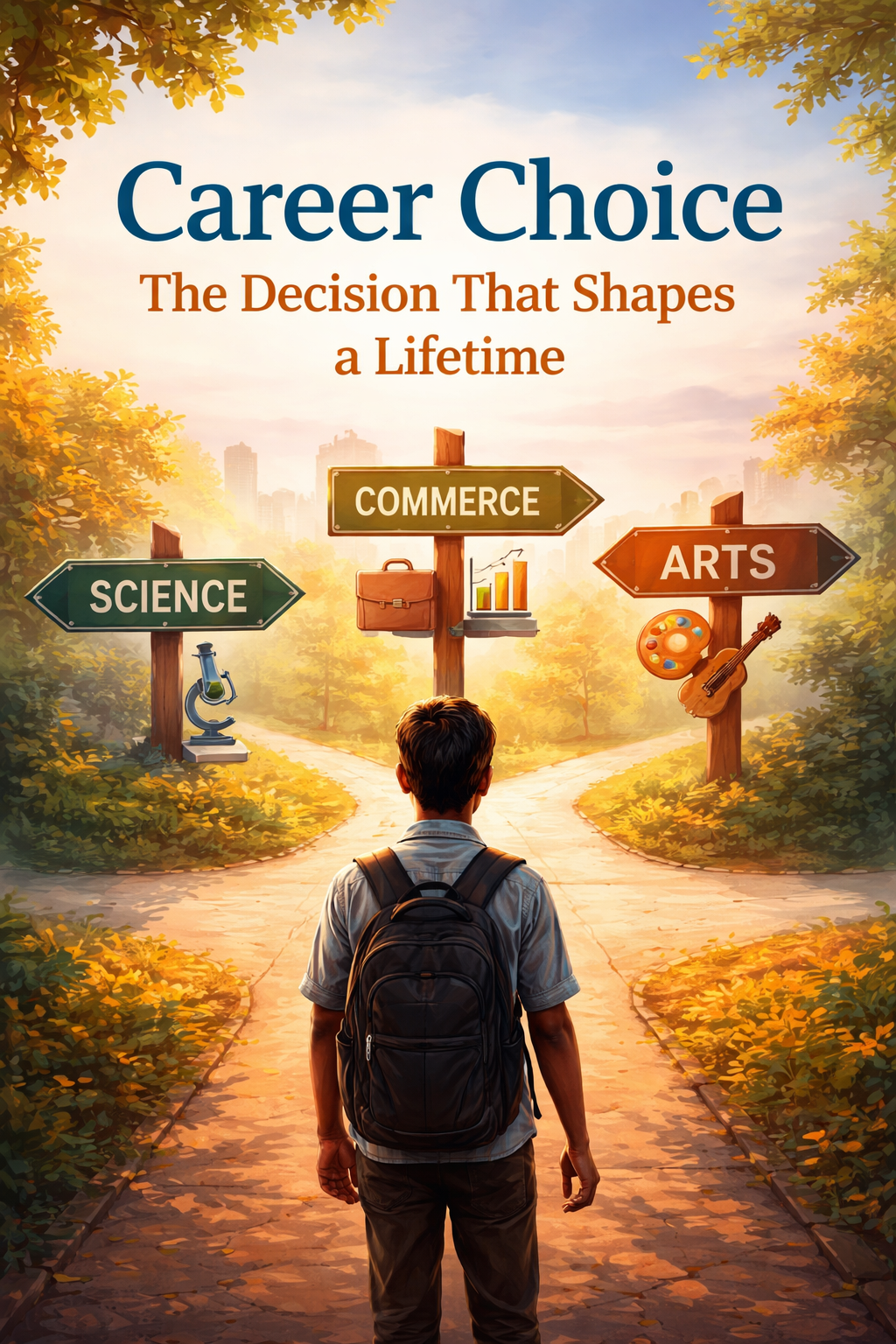
After 10th grade, we choose between Science, Commerce, or Arts. After 12th, we pick a specific degree or career path. These choices shape not only our professional future but also our mental health, self-esteem, and overall happiness.
The irony is simple: at this age, most of us barely know who we are.
⸻
The Illusion of “Smart Choices”
Ask a group of students what they plan to choose after 10th grade, and most will confidently say, “Science.”
Not because they love physics or biology—but because Science is labeled as the “smart” stream.
Commerce and Arts are often treated as backup options.
This social ranking traps thousands of students into careers they never truly wanted, simply because of how intelligence is defined in society.
In India especially, career choices are rarely made based on personal interests. They are driven by social status, family expectations, and income potential.
Parents usually want the best for their children. But in trying to secure their future, they sometimes forget one thing:
Stability without satisfaction leads to burnout.
⸻
A Personal Realization
I remember how confusing it felt during my school years when everyone around me seemed confident about their future—while I wasn’t.
Some chose Science because “top students do that.”
Some chose Commerce because “it has business scope.”
Some chose Arts because “nothing else worked.”
Very few chose based on self-awareness.
Most were choosing out of fear—fear of judgment, fear of disappointing parents, fear of being seen as less capable.
And years later, many of them were still searching for meaning in careers they never truly chose.
⸻
Why Career Counseling Isn’t a Luxury—It’s a Necessity
Most students don’t even know career counseling exists. And those who do often see it as unnecessary.
In reality, a good career counselor can save years of confusion, regret, and emotional struggle.
A counselor doesn’t decide for you.
They help you understand:
• Your strengths
• Your learning style
• Your personality
• Your natural inclinations
Through aptitude tests, personality mapping, and structured conversations, they help you discover what actually fits you.
The goal isn’t just to pick a job.
It’s to choose a direction that aligns with who you are.
According to a 2023 report by the National Career Service of India, nearly 93% of Indian students aged 14–21 are aware of only seven career options, despite there being over 250 viable paths.
This gap exists because most students never receive proper guidance.
⸻
When Wrong Choices Become Lifelong Burdens
Imagine a student who loves art but chooses Commerce to satisfy family expectations.
He struggles. Barely passes. Slowly starts believing he isn’t intelligent.
Another student with analytical thinking is forced into Science, only to realize she hates every minute of it.
This is how bright minds begin to doubt themselves.
Thousands of adults wake up every morning feeling trapped—not because they are lazy, but because they are living someone else’s dream.
We’ve all seen people earning ₹1 lakh a month and feeling miserable, while others earning far less live peacefully.
That’s the difference between working for survival and working with purpose.
⸻
The Role of Parents
Parents play a powerful role in career decisions.
Often with good intentions.
They want security, respect, and comfort for their children.
But sometimes, concern turns into control.
A parent may say,
“I just want you to be safe.”
But the child hears,
“I don’t trust your choices.”
This emotional gap leads to pressure, resentment, and burnout.
Studies show that parental pressure is one of the major contributors to academic stress and youth mental health issues in India.
Listening matters as much as guiding.
⸻
Recognizing Hidden Struggles
Not every struggling student is lazy or careless.
Some deal with:
• Dyslexia
• ADHD
• Learning disabilities
• Anxiety
• Emotional distress
Without proper assessment, they are labeled as “average” or “weak.”
These labels destroy confidence that takes years to rebuild.
A counselor can identify these challenges early and guide students accordingly.
Support changes lives.
⸻
Breaking the Cycle
We must break outdated myths.
Science, Commerce, and Arts are not ranks of intelligence.
They are different routes to growth.
• A student scoring 95% may have strong memory skills.
• A student scoring 45% may have exceptional creativity.
• A child struggling academically may excel in design, sports, film, or entrepreneurship.
Success has many forms.
Schools should normalize career counseling.
Parents should encourage exploration.
Students should see passion as responsibility—not rebellion.
⸻
A Better Way Forward
If you’re a student—or a parent guiding one—remember:
A career is not just about income.
It’s about identity.
Before choosing, ask yourself:
• Do I enjoy learning this subject even when it’s difficult?
• Can I imagine doing this daily without feeling trapped?
• Am I choosing this for myself—or for approval?
Also try:
• Internships
• Job shadowing
• Online skill courses
• Aptitude tests
Explore before you commit.
⸻
Final Thought
The right career gives you peace, pride, and purpose.
The wrong one may pay your bills—but drain your spirit.
So take your time.
Seek guidance.
Talk to counselors.
Listen to experience.
Trust your instincts.
And remember:
You are not choosing just a job.
You are choosing the life you’ll wake up to every day.
Choose wisely.