
By Raj Mistry
We’ve advanced technology so rapidly that we may soon face a new kind of crisis — not biological, but digital.
A digital pandemic.
When Apple introduced the Apple Vision Pro, it felt like science fiction becoming reality. No keyboard. No physical screen. You can watch movies, play games, work, and interact — all inside a digital space layered over the real world.
It’s brilliant. It’s futuristic.
And it’s also slightly terrifying.
Because every major leap in technology has quietly reshaped how we live — and how we connect.
⸻
From Telephone to Smartphone: The First Shift
When the telephone was invented, only a few people had access to it. You had to sit near it. It was fixed to a wall or table. It wasn’t addictive because it couldn’t travel with you.
Then came mobile phones.
Suddenly, we weren’t restricted by wires. We could talk anywhere. That freedom was revolutionary.
Then apps arrived. Games arrived. Social media arrived.
And slowly, phones stopped being communication tools — they became entertainment systems, distraction machines, validation devices.
Now try leaving your house without your phone. It feels like forgetting a limb.
We check it unconsciously. Every few minutes. Sometimes without even knowing why.
⸻
The Quiet Distance
There was a time when families sat together in the evening and talked.
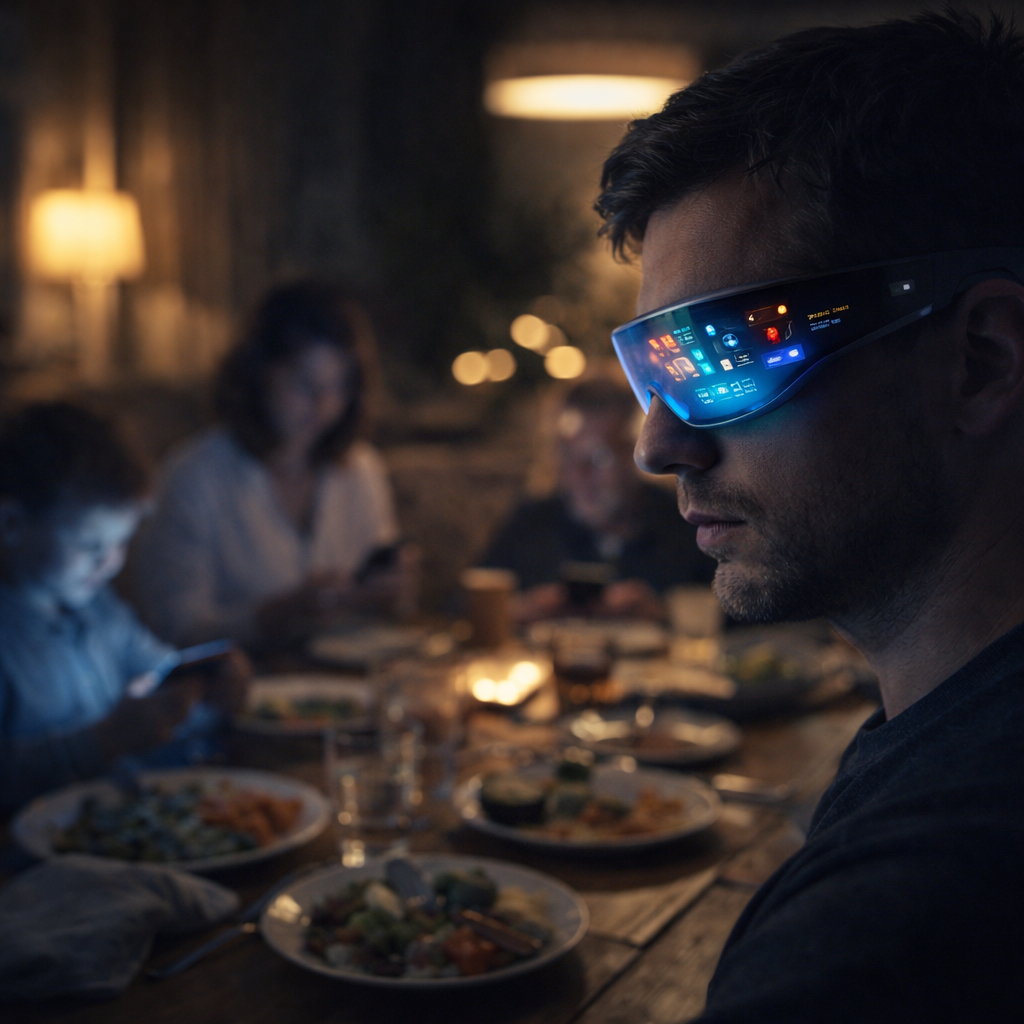
Now we sit at the same table — but everyone is somewhere else.
Kids play less outside. Friends text while sitting next to each other. Conversations have shortened. Attention spans have shrunk.
Then came AirPods.
A small device, but a powerful divider.
In gyms, parks, trains — everyone is sealed inside their own bubble. Small talk disappeared. Random conversations reduced. Even greeting someone feels intrusive when they’re plugged into their own world.
Phones distanced us.
AirPods normalized that distance.
⸻
AI Glasses: The Next Level of Escape
Now imagine something even more immersive.
AI glasses like Apple Vision Pro don’t just distract you — they replace your environment.
Right now, it’s expensive. Not everyone owns one. But technology always follows the same pattern: expensive at first, then cheaper, then everywhere.
When that happens, what changes?
You might sit beside someone and not even notice them.
Friends could gather in one room, yet each person might be in a different virtual space.
Conversations could happen through avatars instead of faces.
We won’t feel the shift immediately. Just like we didn’t realize when smartphones slowly took over our time.
But the more immersive the technology becomes, the easier it is to choose the digital world over the unpredictable real one.
⸻
Why This Is Dangerous
Humans are social creatures.
We grow through eye contact. Through awkward pauses. Through laughter that doesn’t need emojis. Through physical presence.
Technology makes life easier — but it also makes escape easier.
And when life feels stressful, lonely, or disappointing, escape becomes attractive.
AI glasses won’t create loneliness.
But they might amplify it.
Because instead of learning to sit with discomfort, boredom, or real conversations — we’ll have a perfect digital alternative available instantly.
And perfect digital worlds are far more addictive than imperfect human ones.
⸻
Progress or Disconnection?
This isn’t about rejecting technology.
Technology has improved healthcare, communication, productivity, and knowledge access in unimaginable ways.
The danger isn’t innovation.
The danger is dependence.
If we forget how to live without devices…
If we lose our ability to sit in silence…
If face-to-face conversations feel exhausting compared to virtual ones…
Then we are no longer using technology.
Technology is using us.
⸻
The Real Question
The future looks exciting.
Augmented reality. Virtual workspaces. Digital overlays on the real world.
But here’s the question we must ask:
Are we enhancing human life — or replacing human connection?
Because once human interaction weakens too much, going backward might feel like the only way forward.
And history shows something clearly:
Every tool shapes the hand that holds it.
The only thing left to decide is —
are we shaping technology, or is it shaping us?