
By Raj Mistry
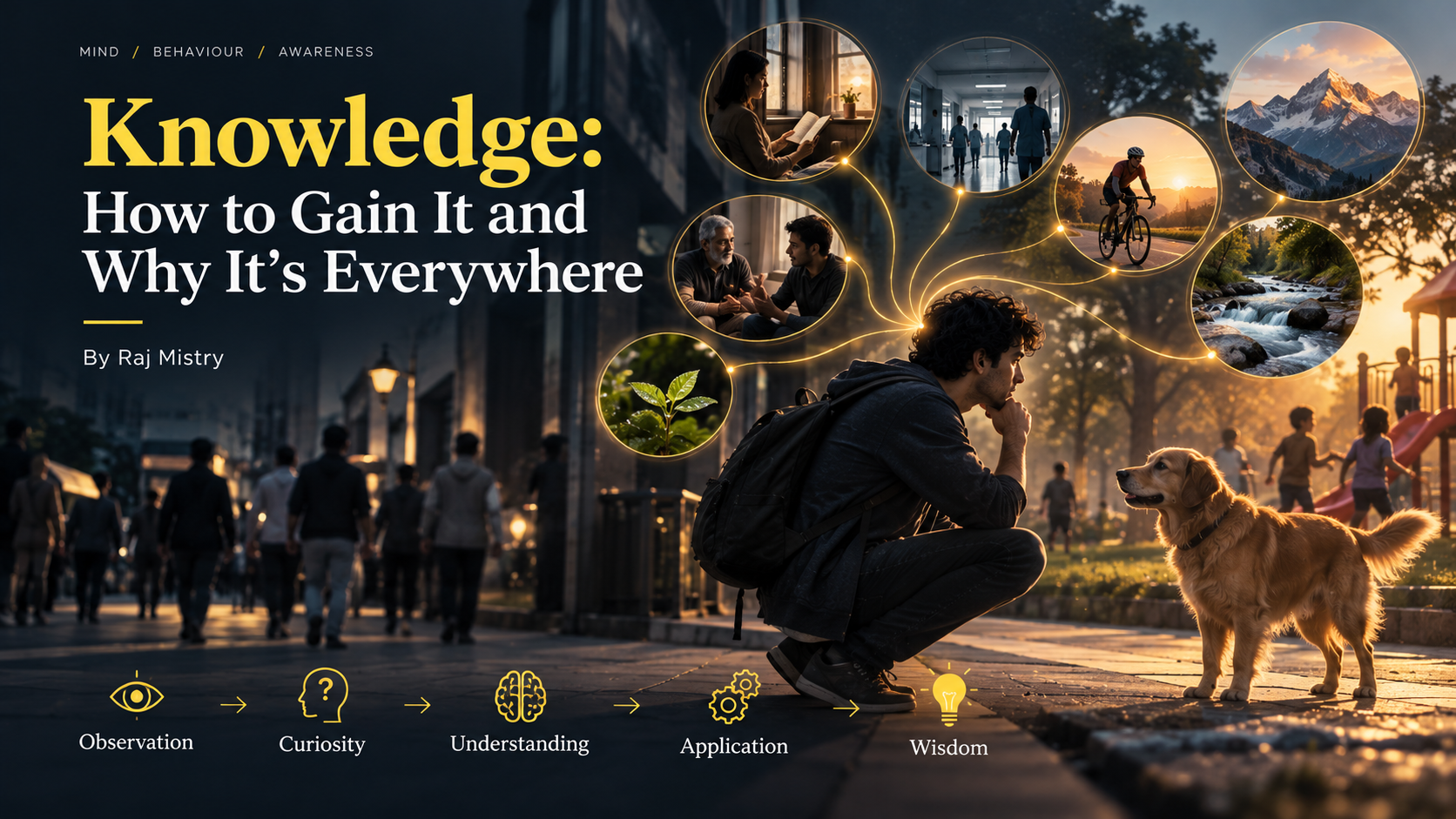
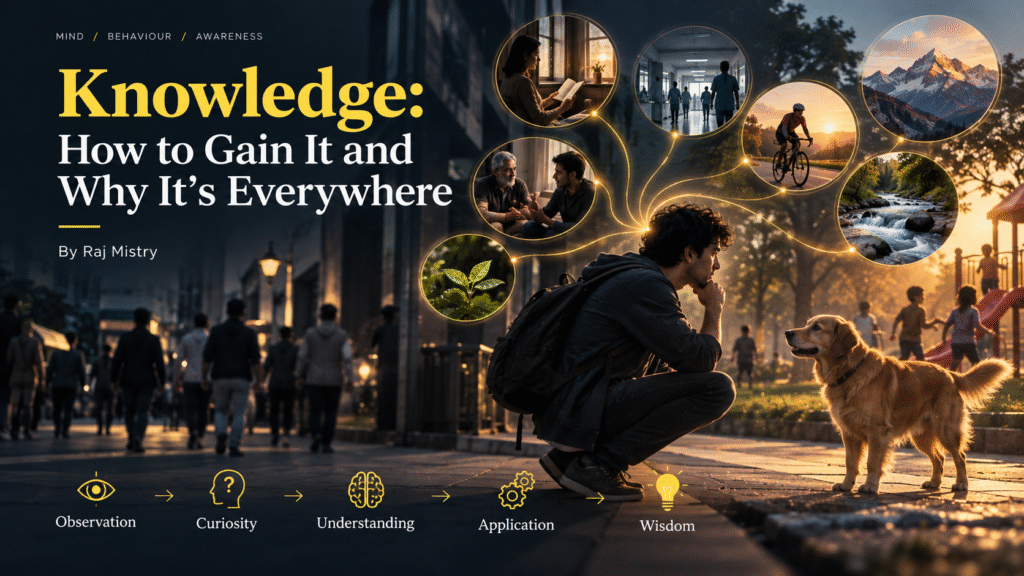
Step outside for a moment. Look around. A dog walks past — watch it. Notice how it moves, what catches its attention, how it reacts when someone reaches out to pet it. Without reading a single word about animal behaviour, you have just learned something. That is knowledge. Not memorised, not studied, not borrowed from a book. Simply observed.
Most people walk past that same dog without seeing anything at all — lost in their thoughts, somewhere else entirely. Same street, same dog, completely different experience. The difference between them is not intelligence. It’s attention.
Knowledge is everywhere. In flowing water and still mountains. In a fight and on a bike ride. In a hospital corridor and on a playground. In the way a fire burns and the way a crowd moves. It is constantly available to anyone willing to look for it. The question is never where to find knowledge — it is whether you have the eye for it.
But before we go further, let’s clear something up — because most people confuse three things that are actually very different.
Memory is your brain’s ability to store and recall information. Knowledge is what happens when you actually understand what you’ve observed or learned. And wisdom is what happens when you take that knowledge and apply it. These three are not the same thing, and mixing them up is where most people get stuck.
You can have a strong memory and still have no real knowledge. You can memorise every line of a book on swimming and still drown. You can read ten books on emotional intelligence and still, when a friend comes to you in distress, offer nothing more than “it’s okay.” The books are there. The memory is there. But somewhere between reading and living, nothing crossed over. That is knowledge without wisdom — and it is more common than we think.
On the other side, you can have courage without knowledge — and that is its own kind of problem. Imagine someone convinced they can jump a river on a motorbike. The courage is real. But courage cannot replace knowing how to build the right ramp, at what angle, at what speed. Without that knowledge, courage is just a faster way to fail. Action without understanding gets you nowhere — or worse, it sets you back.
This is the coin most people are only holding one side of. Some spend their whole lives gathering knowledge and never doing anything with it. Others charge forward without knowing enough to succeed. The people who actually grow — in life, in business, towards their goals — are the ones who understand that both sides matter equally. Knowledge without application is just stored potential. Application without knowledge is just noise.
Think about Bill Gates or Mark Zuckerberg. They had the knowledge. But what if they had never applied it? We would not have Microsoft. We would not have Facebook. Not all wealthy people came from wealthy backgrounds. Not all great thinkers came from educated families. What separated them from everyone else was not luck or privilege alone — it was that they knew something, and then they did something with it.
So how do you actually gain knowledge — real knowledge, not just information?
You observe. Carefully and consistently. Watch how people behave in different situations. Notice what causes a reaction and what doesn’t. If you don’t know how to drive, sit beside someone who does and watch their hands, their eyes, their timing. If you want to understand how to fight, watch how someone moves their body before they throw a punch. You don’t always need a classroom. Sometimes the most useful education is just paying close attention to what is already in front of you.
You listen. Sit with people — really sit with them. Let them tell you about their life, their failures, their choices. Every person who has lived longer than you, struggled differently than you, or succeeded in a way you haven’t yet — they carry knowledge you don’t have. Their experience is a shortcut you are refusing if you are not listening.
You stay curious. The person watching the dog learns something. The person lost in thought learns nothing. The only difference between them is that one is asking quiet questions — why is it behaving that way, what does that reaction mean, what can I take from this — and the other isn’t asking anything at all. Curiosity is the engine behind everything. Without it, even the most obvious lessons walk right past you.
And here is something worth knowing about knowledge that people rarely talk about: it keeps your mind alive. Learning new things, noticing new patterns, picking up new skills — all of it keeps your brain active and sharp. It slows the mental aging that comes from routine and repetition. Something as small as learning to identify a bird by its call might seem useless — until you’re on a jungle safari and suddenly you’re the most interesting person in the group. Or until that same habit of noticing small details saves you in a situation where most people would be lost.
Knowledge about how to build a fire, how to set up a shelter, which plants are safe and which aren’t, how to treat a wound with what’s around you — none of that feels urgent until it is. And then it’s everything.
But you don’t have to wait for a jungle to make knowledge useful. Every single day offers it. The street outside. The conversation at lunch. The problem at work. The relationship that confuses you. All of it is material — if you are willing to look at it that way.
Be observant. Sit with people. Learn from their stories and their mistakes. Be willing to accept knowledge from wherever it comes — not just from sources that feel official or impressive. And once you have it, use it. Apply it. Let it change how you act, not just how you think.
Knowledge is not sitting in a library waiting for you. It is already everywhere around you. You just have to look.