

By Raj Mistry
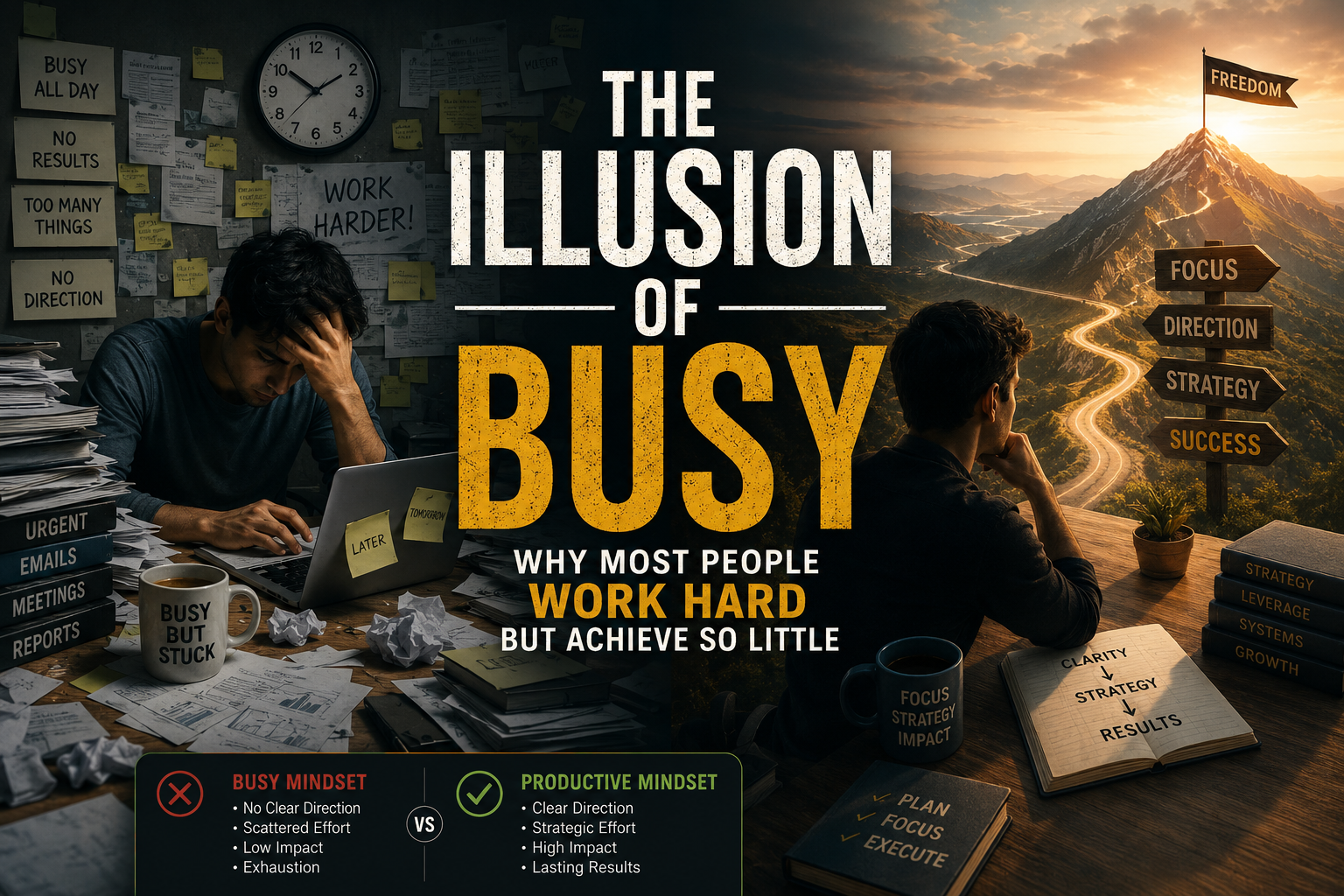
Being Busy Is Not the Same as Being Productive
Most people are not failing because they are lazy. They are failing because their effort is going in the wrong direction.
Since childhood, we’ve been told: “Work hard and you’ll succeed.”
But if hard work alone guaranteed success:
- every laborer would be rich,
- every student studying all day would top the class,
- and everyone working overtime would be financially free.
Reality clearly shows otherwise.
Many people work until exhaustion and still see no real progress in life. Not because effort is useless — but because effort without clarity often becomes wasted movement.
Busy Without Progress
A student can sit with books for 8 hours and still not complete a single chapter. Technically, he “studied all day.” But mentally, he was distracted, unfocused, or simply forcing himself to sit there.
Time was spent. Progress was not made.
That’s the difference between activity and effectiveness.
The same thing happens in real life.
An ironsmith hits metal with full force for hours and earns little. A goldsmith works with smaller, more precise movements and earns far more. The difference is not who worked harder. The difference is where the skill is applied and how valuable the outcome becomes.
Like I mentioned in a previous article: an artist selling paintings on the street and an artist selling inside an auction may have equal talent — but completely different results.
Same skill. Different environment.
Why People Stay Trapped in “Fake Productivity”
Most people stay busy because busyness feels productive. Psychologically, movement feels safer than stillness.
Planning feels uncomfortable. Thinking deeply feels slow. Learning from experts hurts the ego.
So instead, people keep repeating familiar actions even when those actions clearly produce no results.
Some common reasons:
- Action feels more comforting than strategy.
- “At least I’m trying” sounds emotionally safer than admitting confusion.
- People avoid mentors or expert guidance.
- Their environment normalizes mediocrity.
- They take advice from people who are equally stuck.
It’s like digging randomly in a desert hoping to find water — without ever checking where the well actually exists.
The brain often prefers familiar struggle over unfamiliar improvement.
Where You Work Matters More Than How Hard You Work
Many people confuse effort with leverage.
A manager may work fewer physical hours than employees but earns more because he operates at a higher decision-making level. A jockey earns from the race outcome, not the horse carrying the weight.
That’s how life works too.
You could clean all day in a desert and still change nothing. You could spend years breaking through a mountain while another person simply found a tunnel already built on the other side.
Hard work without direction becomes a slow form of failure.
The world doesn’t reward suffering alone. It rewards value, positioning, and impact.
The Difference Between Hard Work and Smart Work
There’s a famous story about a factory machine that suddenly stopped working.
The owner called several mechanics. Money was spent, but nobody could fix the problem. Finally, an experienced expert arrived. He inspected the machine quietly, picked up a hammer, and gave one small hit at a specific spot.
The machine instantly started working again.
The owner became angry: “Why should I pay you thousands for one hammer hit?”
The expert replied:
“The hit costs very little. Knowing where to hit is what you’re paying for.”
That is the difference between effort and expertise.
Some people keep swinging harder with no understanding. Others pause, observe, think clearly, and solve the problem with precision.
Hard Work Alone Is Not Enough
Hard work is important. But glorifying exhaustion without results is dangerous.
Many people stay stuck because:
- they work hard on low-value things,
- they never improve strategy,
- they avoid learning,
- and they repeat the same mistakes every year expecting a different outcome.
Being constantly busy does not automatically mean you are moving forward.
Sometimes it simply means you are trapped in motion.
The Final Reality Check
Stop worshipping busyness.
Stop collecting struggle stories as proof of effort.
If your actions are not creating results, don’t defend the struggle — change the approach.
Learn better systems. Seek guidance. Choose environments that reward your abilities.
Because life rarely pays people for how tired they are.
It pays them for:
- clarity,
- precision,
- value,
- and impact.
Hard work matters.
But hard work without direction is just exhaustion with good marketing.