
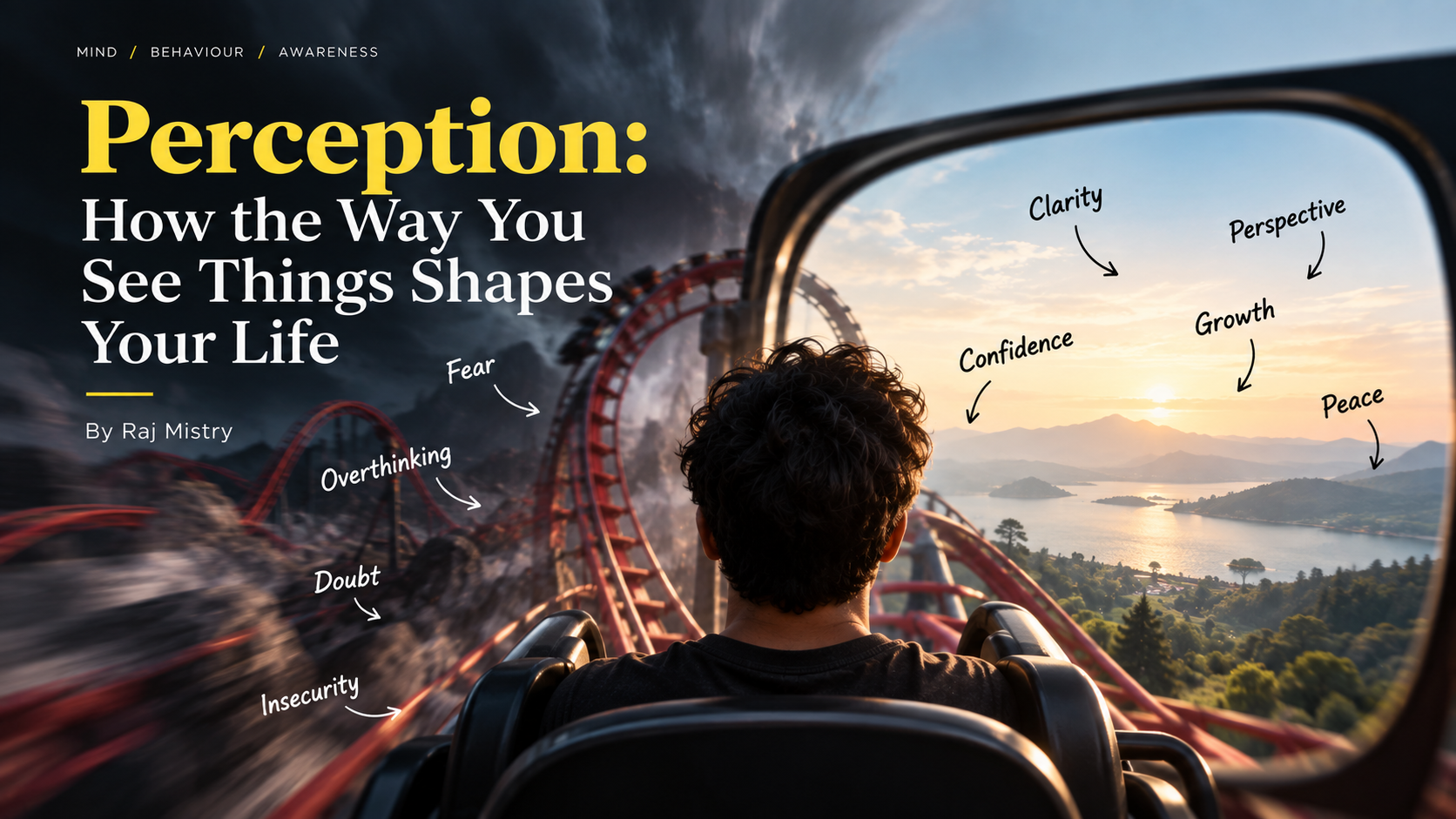
One time I was on a simulated rollercoaster. It was going crazy — making all kinds of twists and turns, and it felt too real. So I reminded myself: I am sitting on a chair. I am not actually on a rollercoaster. Just thinking that helped me. I felt okay almost instantly. Once my mind accepted it, I became calm. That’s how easy it can be. You don’t always need to change the situation. Sometimes you just need to change how you see it.
That’s what perception really is. It’s not just a fancy word. It’s the lens through which you experience everything — every situation, every relationship, every version of yourself. And what most people don’t realize is that this lens is not fixed. You built it. Which means you can rebuild it.
But before we get to that, let’s understand how it works against us — because it does, more often than we think.
We have a deeply biased way of thinking. We see what we want to see. We hear what we want to hear. That’s exactly why arguments go nowhere — because both people are listening to the argument they already prepared in their head, and missing what the other person is actually saying. Nobody is really listening. Both are just waiting to speak.
You may have noticed this in a smaller way too. You know those Instagram reels where words flash on the screen while someone speaks? Your brain makes you hear the words you’re reading, even if the person said something slightly different. That’s your brain filling in gaps with what it expects. Same with visuals — when you focus hard on one thing, everything around it disappears from your awareness. Your brain is constantly editing reality for you, often without your permission.
There’s a study that captures this perfectly. A group of people were told they would go into a job interview with a visible scar on their face. They were made to feel self-conscious about it. But right before they walked in, without telling them, the experimenter removed the scar. And when these people came out of the interview, they said they felt discriminated against. They noticed people staring. They felt judged. Not because it happened — but because they expected it to happen. Their perception created an experience that wasn’t even real.
That’s how powerful this thing is. And that’s also how dangerous it can be when left unchecked.

Think about relationships. If you constantly suspect your partner of being unfaithful, you will find proof everywhere — in a delayed reply, in a laugh that seems too comfortable, in silence that feels like hiding something. Your perception will slowly poison something that might have been perfectly fine. On the other hand, if you carry a secure and trusting lens into the same relationship, you’ll experience it completely differently. Same relationship. Completely different life.
The same principle applies to how you see yourself. And this is where it really matters.
Did anyone ever teach you to feel inadequate? To question yourself before you even try? To feel like a failure, even without actually failing? Probably not consciously — but somewhere along the way, most of us trained ourselves into exactly that. And now that belief runs quietly in the background, shaping every decision, every risk we don’t take, every opportunity we talk ourselves out of.
If you have no faith in yourself, even the smallest task starts to feel like a wall you can’t climb. Not because the wall is too high — but because you’ve already decided you can’t. You’ve been convincing yourself for so long that you’re not enough, that it has become the truth you live by. And the hard truth is: that’s what’s stopping you. Not your circumstances. Not your background. Your own perception of yourself.
History is full of people who had every reason to give up — and didn’t. Not because they were lucky or born special, but because they had a perception that failure was feedback, not a verdict. They stayed persistent. They kept experimenting. And here’s what’s interesting: one real experiment often taught them more than years of preparation ever could.
There’s a well-known study about pottery students. One group was told to make the most perfect pot they could. The other group was simply asked to make as many pots as possible, without worrying about perfection. At the end, the group that made the most pots also made the best ones. Because they weren’t paralyzed by the fear of getting it wrong — they were too busy doing, learning, and improving with each attempt. The perfection-seekers, on the other hand, were so stuck in their heads that they barely moved.
Action, not overthinking. Experiment, not endless preparation. That’s what builds both skill and confidence.
So how do you actually change your perception? That’s the real question. And the honest answer is: it’s simpler than you think, but it takes consistency.
Start where you’re already strong. Pick something you’re genuinely good at and practice it more. When you see yourself improving, something shifts. You stop feeling like someone who can’t — and start feeling like someone who can. That small shift is everything. It becomes the foundation everything else is built on.
Practice gratitude — not as a cliché, but as a daily discipline. Every morning and every night, write down what is good in your life. Write down what you have achieved, no matter how small. Read it. Let it sink in. Over time, this rewires the lens. Instead of waking up and automatically scanning for what’s wrong, your brain starts to notice what’s right.
Set small targets and actually complete them. Not big, overwhelming goals — small, specific ones. And when you complete them, something very important happens: your brain registers that you are someone who follows through. That registration matters more than you think.
Which brings me to the last piece — and probably the most underrated one. Be stubborn about your commitments. When you say you’ll do something, do it. Not because someone is watching, but because your brain is watching. Every time you make a commitment and abandon it — whether it’s skipping the gym, putting off a task, or choosing the reel over the goal — your brain logs it. Over time, it stops trusting you. It stops sending you motivation. It thinks: why bother, he’s not going to do it anyway.
But when you do what you said you would do — even when you don’t feel like it — your brain starts to see you differently. It starts to think: this person is serious. And when your own brain respects you, your confidence is no longer borrowed from outside. It comes from within.
That’s the real shift. Not some overnight transformation. Not a motivational high that fades by morning. It’s the slow, steady process of proving to yourself — through small actions, repeated consistently — that you are someone who can be trusted. Someone who is capable. Someone who is enough.
Your perception is not your destiny. But right now, it’s running your life as if it is. The good news is, you built it — which means you can rebuild it. Nobody can do that for you. Not a mentor, not a book, not even the right circumstances at the right time. It starts and ends with you.
The rollercoaster was never real. But how I chose to think about it — that made all the difference. The same is true for you.