
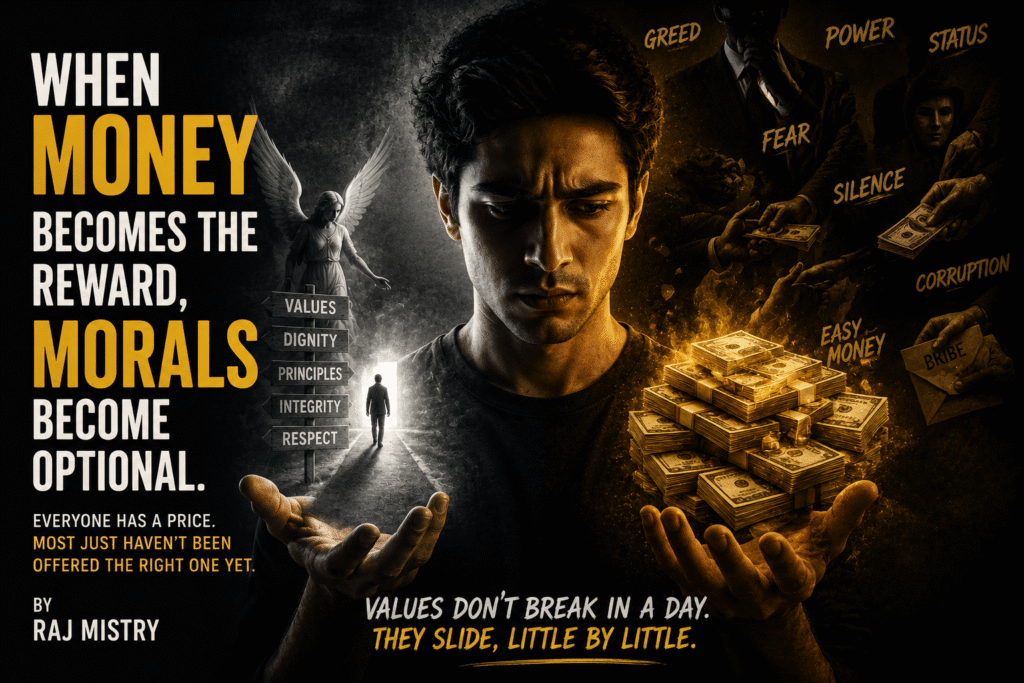
By Raj Mistry
Society today is obsessed with money.
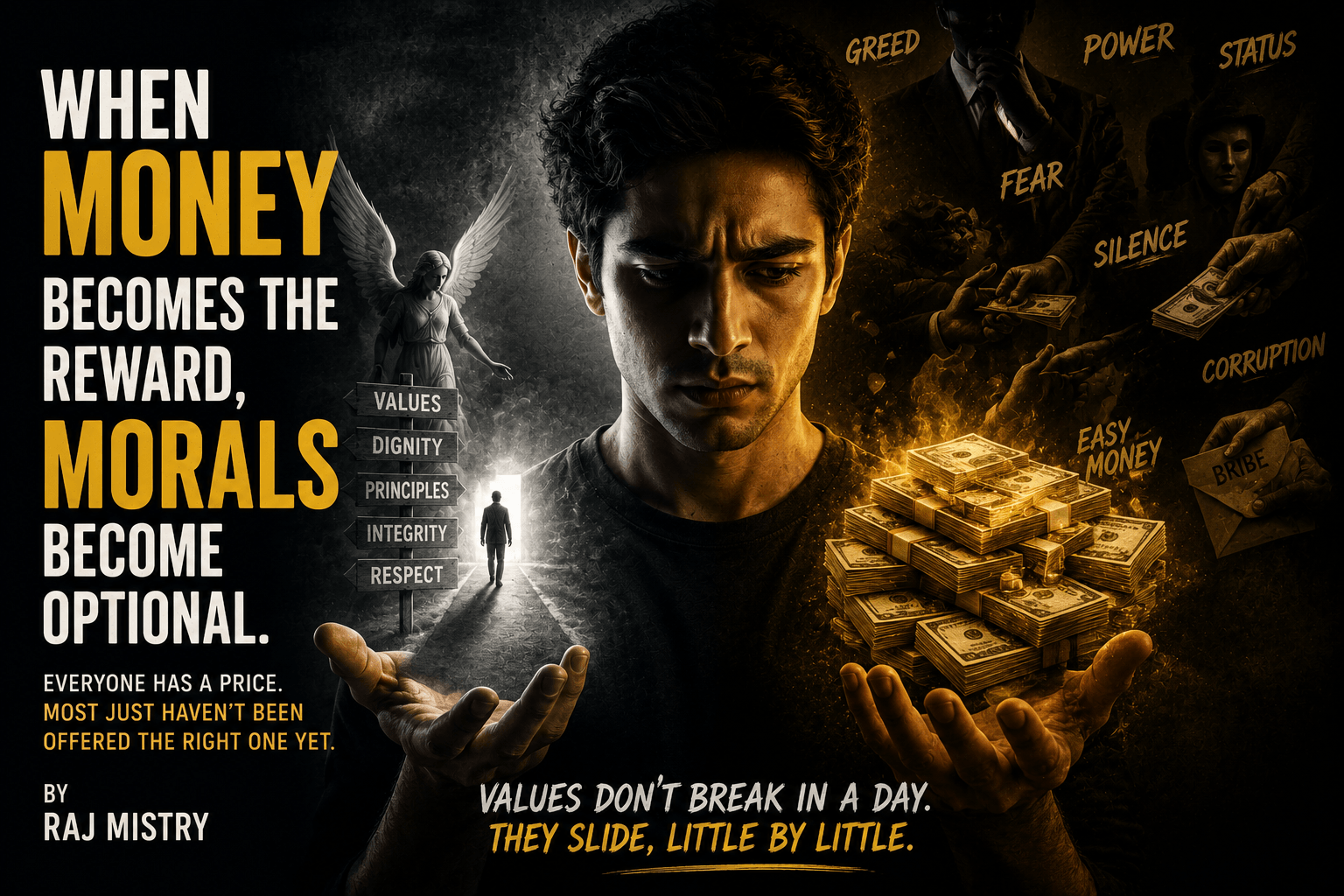
Everyone talks about morals, values, dignity, principles — until money enters the room. Suddenly the same people who were giving life lessons start bending their own rules.
We all love to believe we are moral. But morality is steady only when it’s not tested. Once the “right amount” is offered, everything gets blurry.
There are entire websites where people wait for strangers to pay them to do strange things. It’s disguised as “fun challenges,” but in reality, everyone is simply waiting for a number that feels worth crossing their own line. For the right price, people do things they said they would never do.
Squid Game Wasn’t Fiction — It Was a Mirror
At the start, players were horrified at the violence. But the moment they saw the mountain of money, their morals melted faster than ice in the sun.
The more money added into the pot, the faster their greed grew. Soon they weren’t thinking, “How do I survive?” They were thinking, “How many people do I need to eliminate to win more?”
Even the nicest people can turn ruthless when money becomes the reward.
People proudly say “I would never do this.” But ask them “How much?” — and you will see a different version of them appear. Everyone has a breaking point; most people just haven’t met theirs yet.
⸻
When Survival Pushes People Past Their Limits
It’s not always greed. Sometimes morals collapse simply because survival is at risk.
A father trying to feed his children will cross lines he never imagined. Stealing, threatening, assaulting, dealing in illegal things — survival makes everything seem justified.
It’s not noble. It’s not right. But it is reality. When a person feels pushed into a corner, morality becomes a luxury. They will do anything to stay alive. And when someone cannot fight or find a way out — the next exit becomes suicide.
We judge people for their actions, but we rarely ask what desperation pushed them to that point.
⸻
How Money Buys Status, Respect, and Silence
Money gives status.
Money gives respect.
Money gives silence from society.
If you look rich, no one asks, “How did you earn it?” They only ask, “Teach me how to do it.”
Human traffickers don’t work for morals. They work for money. From kidnapping children to selling women to brothels — these horrors continue because the money behind them is massive.
Lawyers defend criminals knowing they are guilty. Doctors force unnecessary tests to increase bills. Officials take bribes to approve things they shouldn’t. Corruption survives because money keeps feeding it.
People say “I stand for truth,” but will lie, cheat, betray, or manipulate if it means survival or success.
Money doesn’t just move the world — it bends the morals in it.
⸻
The OF Culture Example: Morals Shift When Money Enters the Chat
Not criticizing anyone — people are free to choose — but OnlyFans (and similar platforms) show how fast morals shift when money appears.
Were all creators in desperate need? Some yes. But definitely not all.
Why did many start?
• Because they saw others living the life they wanted
• Because jealousy kicks in when someone earns millions doing something you never imagined
• Because easy money looks more tempting than slow progress.
People who once opposed wearing shorts in public now share intimate content online. Not because their values changed — but because money changed the value of their values. Morals feel flexible when the “reward” feels big enough.
⸻
History Has Always Shown That Morals Break Under Pressure
Look at Mahabharata. A culture where women were respected like goddesses. Yet Draupadi was gambled away like property.
Were those men moral? Yes — until the game and the desire to win clouded everything. Morality failed in front of temptation.
This pattern repeats through time. And it repeats today.
⸻
Why Every Industry Has a Price
Casting couch exists because people want fame more than dignity. Office affairs happen because promotions seem more important than loyalty.
Employees tolerate exploitation because losing income is scarier than losing pride. People compromise not because they are bad — but because the world is structured in a way that punishes honesty and rewards shortcuts.
Morality is expensive.
Money is convenient.
⸻
The Small Daily Compromises Nobody Talks About
Most moral failures aren’t dramatic. They happen quietly — in grocery stores, offices, and daily interactions.
A shopkeeper overcharges tourists. Someone keeps extra change the cashier mistakenly returned. Employees mark “working” while scrolling Instagram. People lie on resumes, cheat on taxes, and take credit for someone else’s work.
These don’t look immoral — they look “practical.” But morality doesn’t break instantly — it slides, inch by inch.
Each small excuse becomes a habit. Each habit becomes a pattern. Each pattern becomes your character.
People rarely think “I’m doing wrong.” They think, “It’s just this once.”
⸻
Why Fear Is as Powerful as Money
Money is powerful. But fear is just as strong.
Fear of losing income.
Fear of losing position.
Fear of losing comfort.
Fear of losing status.
Employees stay silent about corruption because they don’t want to lose their job. People support decisions they disagree with because they want safety.
Silence becomes easier than honesty.
Ethics stop being values — they become luxuries.
⸻
Greed vs Reality: Why Almost Everyone Breaks Eventually
A poor man may be honest — until someone places ₹10 lakh in front of him. A rich man may be kind — until his power is threatened. A loyal person may stay faithful — until temptation arrives with the “right amount.”
Everyone believes they know their limits. But we don’t really know ourselves until life tests us.
The real question is not: “Am I moral?”
The real question is: “Has life tested me deeply enough yet?”
Most people look moral only because their price hasn’t been offered.
⸻
Final Thought
Morality is steady when life is steady. The real test begins when money, survival, fear, or temptation enter the picture.
So the question isn’t: “Are we moral?”
The question is: “Have we ever been tested?” And if the test comes, “Will we choose values… or price?”
Most people already know the answer — they just don’t want to say it out loud.